

Applying to a European medical university sounds exciting until you realize that every country has different deadlines, every university has its own document checklist, and one missed requirement can cost you an entire academic year. For international students and their families, this process can feel like solving a puzzle with half the pieces missing. The good news is that a clear, structured workflow removes most of that uncertainty. This guide walks you through every stage of the application process for English-taught medical programs in Europe, from gathering your first documents to confirming your acceptance and preparing for arrival.
Table of Contents
- What you need before you start
- Step-by-step workflow for applying to European medical universities
- Troubleshooting: Common obstacles and mistakes
- Verification and next steps after acceptance
- Get personalized guidance for your admission workflow
- Frequently asked questions
Key Takeaways
| Point | Details |
|---|---|
| Collect documents early | Gather transcripts, proof of English, and ID well before applications open to avoid delays. |
| Follow stepwise process | Break the application into clear stages: eligibility, documents, exams, interviews, and offer. |
| Avoid common mistakes | Double-check deadlines and requirements to prevent admission delays and frustration. |
| Verify after acceptance | Confirm your offer, complete visa requirements, and plan for your move to Europe. |
What you need before you start
Before you even look at university websites, you need to know exactly what you're bringing to the table. Think of this phase as packing for a long trip. If you forget something essential, you can't just run back home.
European admission requirements vary by country and institution, but the core documents are consistent across most programs. Common admission requirements include proof of secondary education, English proficiency, and specific science backgrounds. Here's what most universities will ask for:
- Official high school transcripts (translated and notarized if not in English)
- Proof of English proficiency (IELTS, TOEFL, or equivalent)
- National ID or passport copy
- Personal statement or motivation letter
- Letters of recommendation (usually two, from science teachers or counselors)
- Proof of science prerequisites (biology, chemistry, and sometimes physics)
The science prerequisites are worth paying close attention to. Most programs expect you to have studied biology and chemistry at a high school level, and some universities in countries like Poland, Hungary, and the Czech Republic require a minimum grade in these subjects.
EU vs. non-EU applicants: EU students often benefit from simplified document verification through the Bologna Process framework. Non-EU students typically need additional steps, including credential evaluation and sometimes apostille certification of their documents.
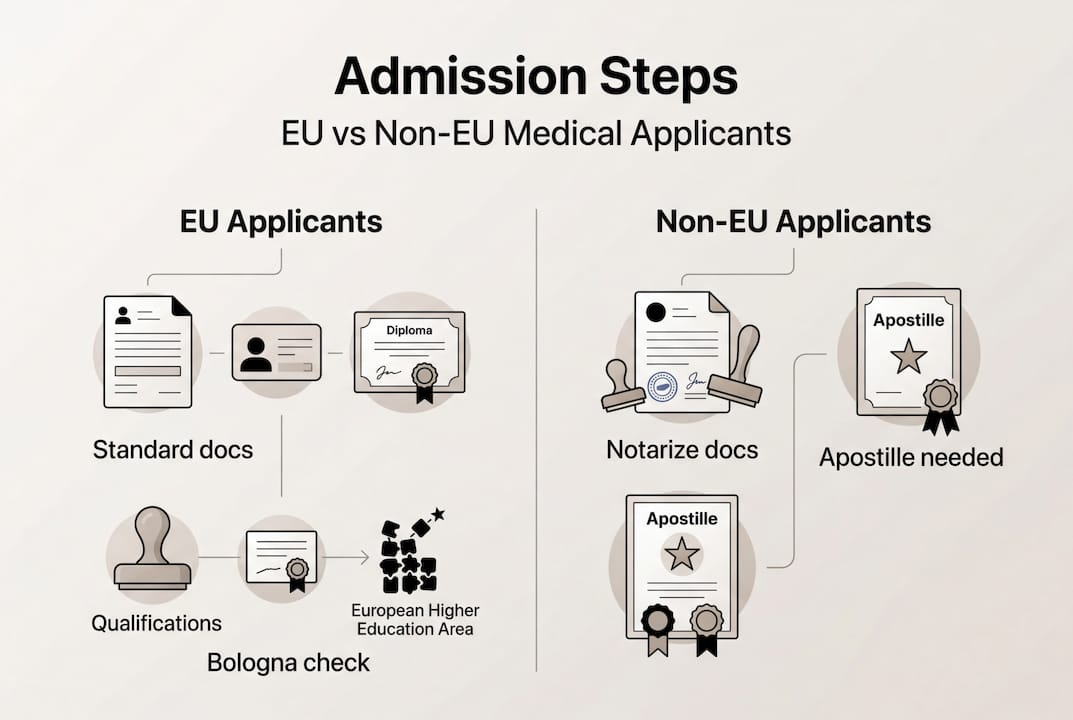
| Document | EU applicants | Non-EU applicants |
|---|---|---|
| Transcripts | Standard submission | Notarized + apostille |
| English proof | IELTS/TOEFL | IELTS/TOEFL |
| ID verification | National ID accepted | Passport required |
| Credential evaluation | Often automatic | Usually required |
Pro Tip: Start collecting documents at least three months before the application window opens. Notarization and apostille processes can take weeks, and translation services add more time on top of that.
Step-by-step workflow for applying to European medical universities
With your documents ready, you can move through the admissions process with confidence. The detailed application steps follow a consistent pattern across most European universities, even if the specifics differ.
- Confirm eligibility and choose universities. Check each university's specific GPA requirements, science prerequisites, and language scores. Shortlist three to five programs that match your profile.
- Prepare and upload all required documents online. Most universities use dedicated application portals. Scan documents at high resolution and label files clearly before uploading.
- Register for entrance exams where applicable. Countries like Hungary and Slovakia require entrance exams in biology and chemistry. Register early because exam slots fill up fast.
- Complete interviews and assessments. Some universities conduct online or in-person interviews. Prepare by reviewing basic medical ethics, your motivation for studying medicine, and current health topics.
- Track results and accept offers. Admission results are typically released within four to eight weeks. Once you receive an offer, you usually have a short window (sometimes as little as two weeks) to accept and pay a deposit.
The European admission workflow looks different depending on whether you apply directly or through an education consultancy.
| Factor | Direct application | Agency-assisted |
|---|---|---|
| Time investment | High | Moderate |
| Error risk | Higher | Lower |
| Cost | Lower upfront | Service fee applies |
| Guidance level | Self-directed | Expert support |
| Deadline tracking | Manual | Managed for you |
Pro Tip: Set calendar reminders for every deadline, including document submission, exam registration, interview scheduling, and offer acceptance. Missing any single one can push your start date back by a full year.
Troubleshooting: Common obstacles and mistakes
Even well-prepared students run into problems. Knowing what typically goes wrong gives you a real advantage.
Common admission mistakes include incomplete documentation and misunderstanding exam dates, both of which cause significant delays. Here are the most frequent issues and how to handle them:
- Incomplete paperwork: Double-check every document against the university's official checklist before submitting. One missing page can put your application on hold.
- Missing English proficiency scores: Some students assume their school's English instruction is enough. It isn't. Most programs require a formal test score.
- Misreading exam dates: Entrance exam schedules are often listed in local time zones. Confirm the time zone and set your registration alarm accordingly.
- Late credential evaluation: Non-EU students who wait too long for credential evaluation often miss early application rounds entirely.
- Ignoring prerequisite grades: Submitting an application without meeting the minimum grade in biology or chemistry is one of the most avoidable mistakes.
"Over 30% of admission delays stem from documentation errors."
The application troubleshooting tips that matter most are the simple ones: read every instruction twice, keep copies of everything you submit, and follow up with the admissions office if you haven't received a confirmation email within five business days.
Verification and next steps after acceptance
Getting an offer letter is a milestone, but it's not the finish line. What you do in the weeks after acceptance determines how smoothly your first semester begins.
First, confirm your offer formally. Most universities require a signed acceptance form and a deposit payment to secure your place. Missing this step means your spot goes to the next candidate on the waitlist. Official student guidelines outline that students must confirm offers, complete visa formalities, and prepare for university life before arrival.
Here's what to prioritize after acceptance:
- Visa application: Non-EU students need a student visa. Start this process immediately after accepting your offer. Processing times range from four to twelve weeks depending on your home country.
- Health insurance: Most European countries require proof of health insurance before enrollment. Check whether your university offers a student plan or whether you need to arrange private coverage.
- Housing: University dormitories fill up quickly. Apply for on-campus housing as soon as you receive your acceptance, or research private accommodation options near campus.
- Pre-departure orientation: Many universities offer online orientation sessions for incoming international students. Attend these. They cover registration, banking, local transport, and student support services.
- Document copies: Bring certified copies of all your admission documents, visa, insurance, and transcripts. Keep digital backups in cloud storage.
Use the student preparation checklist to make sure nothing falls through the cracks between acceptance and your first day of class.
Pro Tip: Join your university's official Facebook group or WhatsApp community for incoming students before you arrive. You'll find roommate matches, local tips, and answers to questions you didn't even know you had yet.
Get personalized guidance for your admission workflow
Navigating the European medical admissions process on your own is possible, but it's also where most families lose time and make avoidable errors. Vistara Abroad specializes in exactly this kind of support.
From personalized university shortlisting to document review, entrance exam preparation, and visa guidance, Vistara Abroad covers every stage of the workflow described in this guide. The team works with students applying for the 2025/26 academic year and understands the specific requirements of English-taught medicine, dentistry, and health sciences programs across Europe. If you're ready to move forward with confidence, explore personalized admission support and find out how expert guidance can make your application process faster, cleaner, and far less stressful.
Frequently asked questions
What is the minimum English proficiency required for European medical programs?
Most universities require at least a B2 level or IELTS 6.0 for English-taught medical programs. Some competitive programs set the bar higher, so always check the specific university's language requirements.
When is the best time to start preparing documents for admission?
Begin at least two months before the application window opens, and three months if you're a non-EU student who needs credential evaluation. Early document preparation is the single most effective way to avoid last-minute delays.
What if I miss the entrance exam date?
Missing exam dates typically means waiting until the next application cycle, which is a full year away. Confirm all exam dates and time zones well in advance and set multiple reminders.
Do European universities accept applications from non-EU students?
Yes. Most English-taught medical programs across Europe actively welcome non-EU candidates, though requirements around credential evaluation, visa processing, and document certification differ from those for EU applicants.